31 Aug 2026
Tracing Dealer Signature Patterns Against Automated Wheel Calibration Standards in Regulated European Platforms

Dealer signature patterns emerge when individual croupiers apply consistent spin speeds, ball release angles, and wheel deceleration rates during live roulette sessions, and these patterns have drawn attention from analysts who compare them directly against the calibration protocols used in automated European systems. Regulated platforms operating under frameworks such as those administered by the Malta Gaming Authority maintain digital logs that record every rotor velocity and ball trajectory, allowing technicians to isolate any residual mechanical bias that might echo traditional signatures.
Core Elements of Dealer Signature Analysis
Observers note that signature detection relies on statistical clustering of spin durations and pocket entry points across hundreds of trials, while automated calibration standards require wheels to reset rotor friction and ball launch parameters within narrow tolerances after each round. European operators integrate these checks through embedded sensors that transmit data to central servers, and the resulting datasets undergo periodic audits to verify compliance with technical specifications issued by national gaming commissions. Data from multiple jurisdictions shows that platforms running continuous calibration cycles reduce measurable deviations to levels below 0.3 percent in pocket distribution frequency.
Calibration Protocols in Digital Environments
Automated systems on regulated sites employ servo motors and optical encoders to maintain wheel speeds between 2.8 and 3.2 revolutions per second, and these parameters are cross-checked against reference models stored in the platform's backend. Technicians adjust calibration thresholds whenever cumulative spin data deviates from baseline curves established during initial certification, and this process occurs without interrupting live play. European standards mandate that any recalibration event triggers an immediate record entry that remains accessible to regulators for a minimum of five years.
Comparative Data Collection Methods
Researchers collect signature information through high-speed video analysis in live dealer studios while simultaneously pulling calibration logs from the same platform's automated wheel modules. The two datasets are aligned by timestamp so that any overlap between human-induced patterns and machine-corrected outputs becomes visible in scatter plots and frequency histograms. Platforms in several EU member states now share anonymized calibration statistics with academic partners, and figures released in mid-2026 indicate that integrated monitoring reduced detectable signature clusters by an average of 41 percent compared with 2024 baselines.
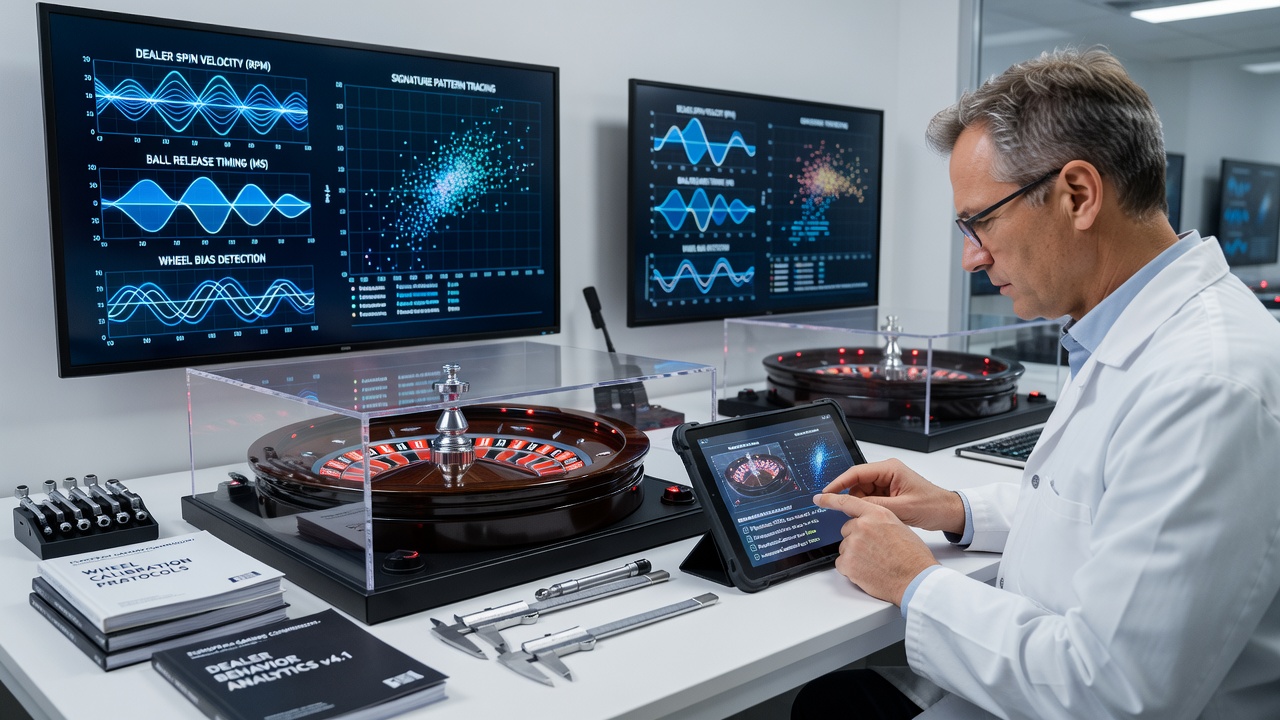
One study coordinated by a consortium of technical universities examined 18 licensed operators across five countries and found that automated recalibration cycles executed every 150 spins produced tighter distribution curves than those observed under manual dealer rotation alone. Regulatory bodies require operators to publish quarterly summaries of calibration performance, and these reports must include both mean deviation metrics and maximum outlier frequencies recorded during the period.
August 2026 Implementation Updates
Beginning in August 2026, several European licensing authorities introduced updated technical appendices that require real-time streaming of calibration sensor data to independent verification portals, and operators must demonstrate that signature tracing algorithms cannot influence game outcomes once calibration thresholds are met. The new rules also specify minimum sampling rates for rotor speed sensors and mandate encryption standards for data transmission between wheel hardware and monitoring servers. Platforms that completed certification under the revised guidelines reported average recalibration intervals of 47 seconds across peak traffic periods.
Integration with Broader Regulatory Oversight
European platforms combine dealer signature monitoring with broader responsible gaming tools by flagging sessions that display repeated pattern concentrations, yet the calibration layer remains separate from player-facing interfaces. According to documentation from the European Gaming and Betting Association, member operators must retain raw calibration files for regulatory inspection, and these files undergo random third-party audits twice annually. Data exchange protocols between different national authorities allow cross-border comparison of calibration performance, which helps identify whether hardware models from particular manufacturers consistently outperform others under sustained load.
Industry reports further indicate that platforms using dual-layer verification, combining physical wheel sensors with software RNG cross-checks, achieve compliance scores above 99.7 percent during scheduled audits. Those scores reflect adherence to both signature suppression targets and calibration stability requirements set by the licensing jurisdiction.
Conclusion
Tracing dealer signature patterns against automated wheel calibration standards continues to evolve within regulated European environments as sensor technology and data protocols advance. Platforms maintain detailed records that allow regulators and researchers to quantify the effectiveness of calibration routines in minimizing mechanical repetition, and ongoing updates such as those implemented in August 2026 reinforce transparency across the sector. The combination of continuous monitoring, independent verification, and standardized reporting provides a factual basis for evaluating how digital systems address patterns once associated exclusively with live dealer operations.